
Criminal Cases in the Oconee County Courts
Oconee County criminal court cases are divided by jurisdiction. Superior Court, part of the Western Judicial Circuit with Clarke County, has exclusive felony trial jurisdiction. State Court handles misdemeanors and traffic offenses within its authority. Magistrate Court handles arrest and search warrants, first appearances, preliminary hearings, and assigned ordinance matters. Juvenile delinquency proceedings have nonpublic access rules, while Probate Court has traffic-citation functions but is not the felony court.
The clerk-held case file is distinct from a sheriff arrest report or jail booking. It follows the prosecution through charging papers, hearings, pleas, motions, disposition, and sentence. Searchers should identify the court before assuming one index covers every Oconee County case.
Which Oconee County Court Has the Case
The original allegation helps identify a likely court, but the filed case controls. A felony generally belongs in Superior Court after early Magistrate Court activity. A misdemeanor may proceed in State Court, and a Watkinsville ordinance or qualifying traffic matter may remain in Municipal Court. Charges can change between arrest and formal filing.
| Court | Oconee County criminal role |
|---|---|
| Superior Court | Felony trials and serious matters within its jurisdiction |
| State Court | Misdemeanors and traffic cases within state-court jurisdiction |
| Magistrate Court | Warrants, first appearances, and preliminary proceedings |
| Municipal Court | City ordinance and qualifying fine-only or traffic cases |
Start with the document already in hand. A warrant or first-appearance notice points toward Magistrate Court, but a later accusation or indictment identifies the prosecuting court. State Court coverage should be confirmed through the clerk because the county's named online route is labeled for Superior and Magistrate Court. A city citation may stay with Watkinsville Municipal Court and never appear as a Superior Court case. This court-by-court check prevents a false conclusion based on one empty search.
How to Search Case Records
Georgia has no single free statewide public criminal-case database. Oconee County provides an official Superior and Magistrate Court Docket Search. Use an exact case number when possible. A name search should be narrowed by date and checked against public case facts so two people with similar names are not confused.
- Open the county launch page and select the available Superior or Magistrate division.
- Enter the exact case number, or use the party name with a useful filing date range.
- Compare the case identifier, court, dates, and public party details before selecting a result.
- Open the event register, note the case status, and read the latest event in sequence.
- Ask the correct clerk for document images, older files, or a certified disposition.
| Field Label | Type | Required | Notes |
|---|---|---|---|
| Court or division | Dropdown or tab | Unspecified | Superior or Magistrate where offered |
| Name or party | Text | One search key | Cross-check common names |
| Case number | Text | Alternative | Use the exact clerk identifier |
| Filing or date range | Date | Optional | Narrows broad results |
| Search or reset | Button | Not applicable | Runs or clears the query |
Oconee County Files Beyond the Index
An online index is not a certified court record and may not include every image. The Oconee County Clerk of Courts public counter is in Room 208 at 23 North Main Street, Watkinsville, Georgia 30677. Published hours are Monday through Friday, 8:00 a.m. to 5:00 p.m. The clerk can be reached at 706-769-3940, and mail may be sent to P.O. Box 1099, Watkinsville, GA 30677.
Ask for a pleading, accusation, indictment, sentencing sheet, judgment, or certified disposition by case number. Older Oconee County files may require staff retrieval. The clerk also advertises electronic certification. Call the relevant clerk separately for a State Court or municipal case not represented in the Superior and Magistrate route.
Before calling, write down the party name, likely filing year, court, and any number shown on the notice. Ask whether the desired item is an index entry, an uncertified copy, or a certified copy. Those products serve different needs. If a document image is not online, that alone says nothing about whether the file exists. The clerk can explain retrieval and delivery options without turning a docket index into evidence of the final result.
What the Case File Shows
An Oconee County criminal case file records what prosecutors filed and what the court did, not merely what an officer alleged at arrest. Read each count separately because one case can contain different results. Financial or bond data may sit in another subsystem.
| Case Number & Court | Unique identifier paired with the court or division. |
|---|---|
| Charging Document | Accusation, indictment, or other filed paper stating the counts. |
| Docket Entries | Dated filings, motions, notices, pleas, judgments, and appeals. |
| Hearing Dates | Published date, time, and location for a scheduled event. |
| Disposition & Judgment | The result assigned to each charge and the court's judgment. |
| Sentence & Conditions | Punishment, probation terms, and other orders after adjudication. |
Reading an Oconee County Docket
The event register is chronological. An early warrant or complaint is not the final charge. An accusation is a prosecutor-filed charging document used where lawful, while an indictment is a grand jury true bill. Later entries may show arraignment, discovery, motions, hearing notices, plea, judgment, sentence, probation issues, or appeal.
Nolle prosequi means the prosecutor formally chose not to continue that charge at that time. A dismissal ends the listed charge without conviction, and an acquittal is a not-guilty result. A guilty plea or verdict supports a conviction unless special statutory treatment changes its public status. A Georgia First Offender discharge should not be reduced to an ordinary conviction label. The Oconee County arrest history page explains why custody data can remain different.
Stages of a Criminal Case
An Oconee County felony can begin with an arrest or warrant, followed by a Magistrate Court first appearance and bond review. The district attorney evaluates what to prosecute. Felony prosecution normally proceeds by indictment unless a lawful accusation or waiver route applies. Some matters end before trial, and counts within one case can follow different paths.
Case flow: Charges Filed › Arraignment › Pretrial › Plea or Trial › Disposition › Sentencing
JusticePath and Certified Oconee County Records
The Clerk of Courts promotes JusticePath as a mobile court-information app. It can help locate court information, but it is not the sheriff's inmate or warrant app and is not proof of current jail custody. Mobile information and the public index are finding aids. A certified disposition comes from the clerk and carries authentication.
The manifest image assigned to this page shows the county's official JusticePath information. The Clerk's JusticePath page explains its role.
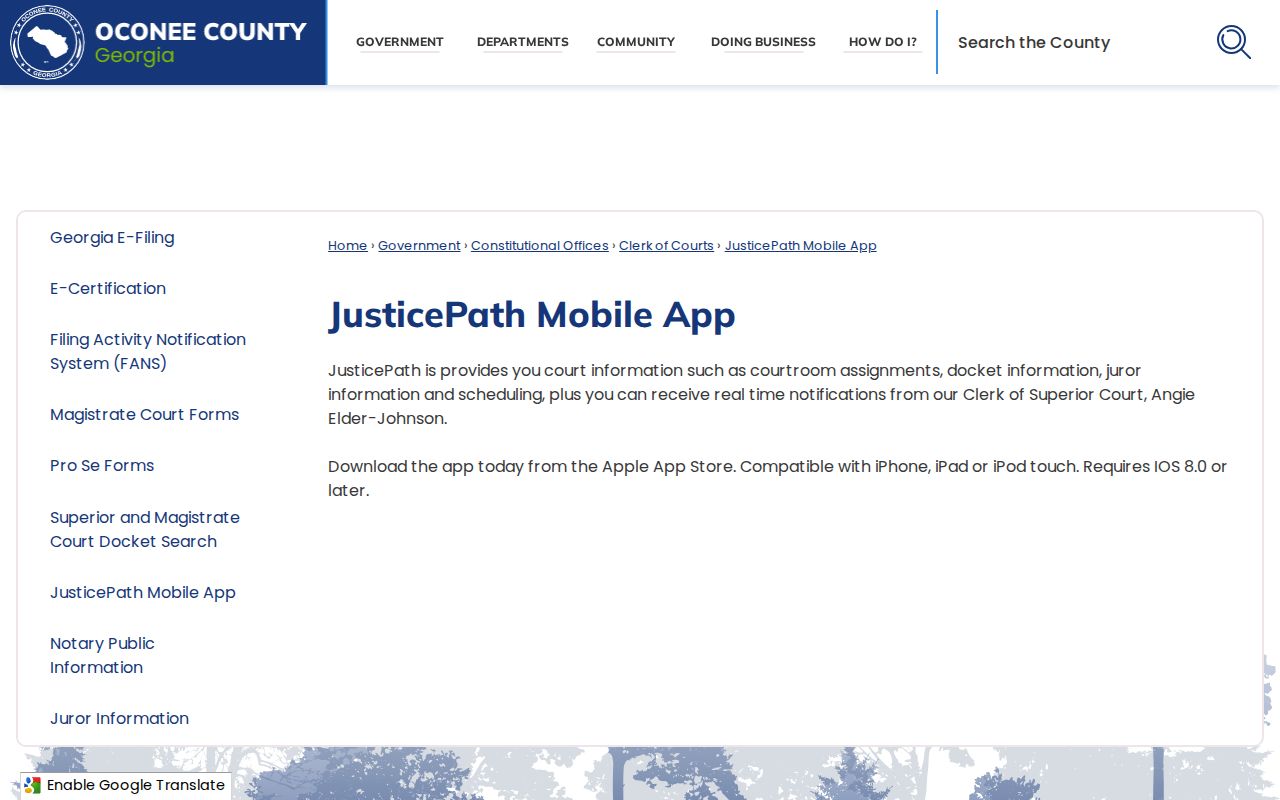
Use it to locate Oconee County court information before requesting the authoritative document from the correct clerk.
Access & Restrictions
Georgia policy favors reasonable access under the Georgia Open Records Act. O.C.G.A. § 50-18-70 states that policy, § 50-18-71 governs responses, production, estimates, inspection, copying, and administrative charges, and § 50-18-72 contains exemptions. The three-business-day provision is a response or availability rule, not a promise of instant production.
Public Oconee County court displays should not expose protected identifiers, confidential juvenile information, sealed documents, or victim-sensitive material. O.C.G.A. §§ 35-3-34 and 35-3-35 also help explain why a public docket, a GCIC history, and a full law-enforcement record differ. Ask the clerk about a missing file and request an estimate when copies, retrieval, or certification may carry a charge.
Correcting an Oconee County Case Result
Record restriction under O.C.G.A. § 35-3-37 concerns eligible GCIC dissemination and does not mean every courthouse document was destroyed. Court sealing can be a separate question. If an Oconee County search no longer shows a matter, do not try to bypass a restriction. A person reviewing an apparent error should obtain the certified disposition, compare it with the GCIC cycle, and use the official correction process. That sequence addresses the source record instead of guessing from a missing web result.